

Most organizations think they have a marketing problem. But what they really have is an identity problem.
Identity, as applied to organizations, is not so different from personal identity — it’s a crisp, clear, and concise articulation about the qualities that make you (or the organization) unique. Identity arises from the unique set of experiences and perspectives that led to the creation of an organization in the first place — and once properly articulated, it can never be duplicated, imitated, or replicated anywhere else.
But sadly most organizations have a really tough time with this, for one simple reason: it’s really hard to get right, and it’s easy to settle for ‘close enough’. The fact is that even in the best of circumstances, it takes a lot of time and effort to nail Identity in an organizational setting. There are usually a lot of stakeholders (founders, executives, long-standing employees, marketing people like me) who have strong opinions and they don’t always align immediately.
It takes time, and a lot of hard work, to get down the core expression of Identity to a place where everyone that looks at it goes “Yes. That’s us.”
But it’s not impossible.
Like Mark Twain is supposed to have uttered, “The right word is the difference between lightning and a lightning bug.”
Getting to that lightning strike, that ‘Aha!’ moment, takes a lot of time, effort, diligence, and patience. It’s easy to skip. But there is one really good reason why you shouldn’t:
This time and effort to get Identity right is one of, if not the, most valuable investments an organization can make.
Identity sits at the core of every single decision an organization needs to make. Having the answer, a tight, cleanly articulated, and narrow definition of what that identity is means that now everyone in the organization is empowered to make decisions quickly, and more correctly. It helps provide the answers to who should be hired, which channels to test, what products to develop, what messages to broadcast, which customers to target, and touches just about everything else.
Identity is the sun around which your organization and all of its decisions orbit — properly defined, it illuminates the right choices and keeps everything spinning in harmony.
Without it, marketing is just a shot in the dark.
Identity (Who) -> Values (Why) -> Mission (What) -> Brand (How)
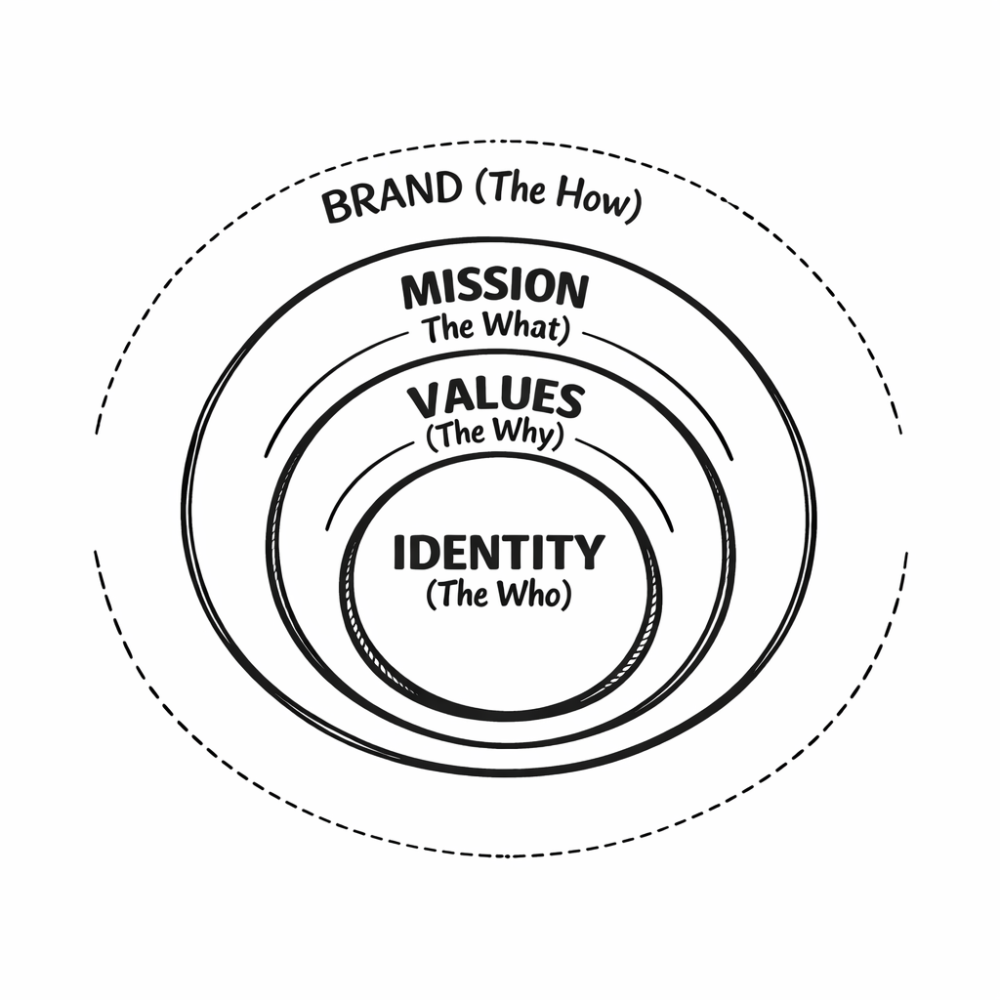
Identity is what gives rise to your organization’s values, which in turn define its mission. The way those are communicated out into the world is the brand. Brand is really just shorthand for Trust. It’s easy (and a lot of fun for marketers and consultants) to dress up Brand as all sorts of things: meaning associations, signifiers, age groups, personality traits, etc etc. But at the end of the day, your brand is simply this: when people see your name, do they trust you?
There is a simple, 3-fold way to build trust through communication and marketing (and of course, your actions had better back this up). The first is by showing Empathy — does this organization genuinely care about what happens to me? The second is by demonstrating Logic — do I understand why this organization does what it does? Is it consistent? The third is through that most elusive, slippery, and overused of terms in modern marketing: Authenticity. Authenticity is a lot like that old line about what constitutes pornography — you know it when you see it. And the reason authenticity is so hard to define, so easy to get wrong, and so often misconstrued is that it is directly connected to Identity — and without it, it’s easy for those efforts to fall flat, often in an embarrassing way.
All of this is not to say that it’s impossible to be successful without a clearly defined Identity. I’d even go so far as to say that the majority of organizations operate without it — and, yes, they can and do still reach customers, make lots of revenue, and launch successful campaigns and products. But there is a major catch: it’s far less efficient. It involves lots of wasted effort (and spending), hit and miss results, and dilution of brand that risks the organization’s image with each new campaign. Instead of consistent effort in the right direction time and time again, organizations without it are striking out, zigging and zagging, going after the wrong customers for the wrong reasons, scratching their heads after a campaign fails and not understanding why.
This is because of the importance and power of storytelling. Stories are how human beings make sense of the world around us — the past, present, and future of our lives, the connections we build with others, and our own place in it. Marketing is really storytelling in disguise.
Now, think about your favorite stories — what separates something that’s just OK from something that sticks with you forever? Is it because of the plot? Rarely. Plots get re-used and recycled all the time, but what really separates a great story from a mediocre one is character. (And that’s where Identity comes in.)
Without a clear understanding of your organization’s Identity, it is simply impossible to tell a consistent story. If you don’t know your own story, how can you possibly tell it to others? (Answer: You can’t.) And that consistency is the core of what it means to be authentic. Without it, authenticity is window dressing. Logic is opaque. And declarations of empathy can’t be trusted.
Here’s what all this means. Identity is not just a ‘nice to have’. It is the foundation upon which a brand is built, the wellspring of inspiration, the sun at the center of the solar system that holds everything together. Ignore it, and marketing becomes a constant struggle, a guessing game, and unpredictable. Get it right, and success becomes inevitable.